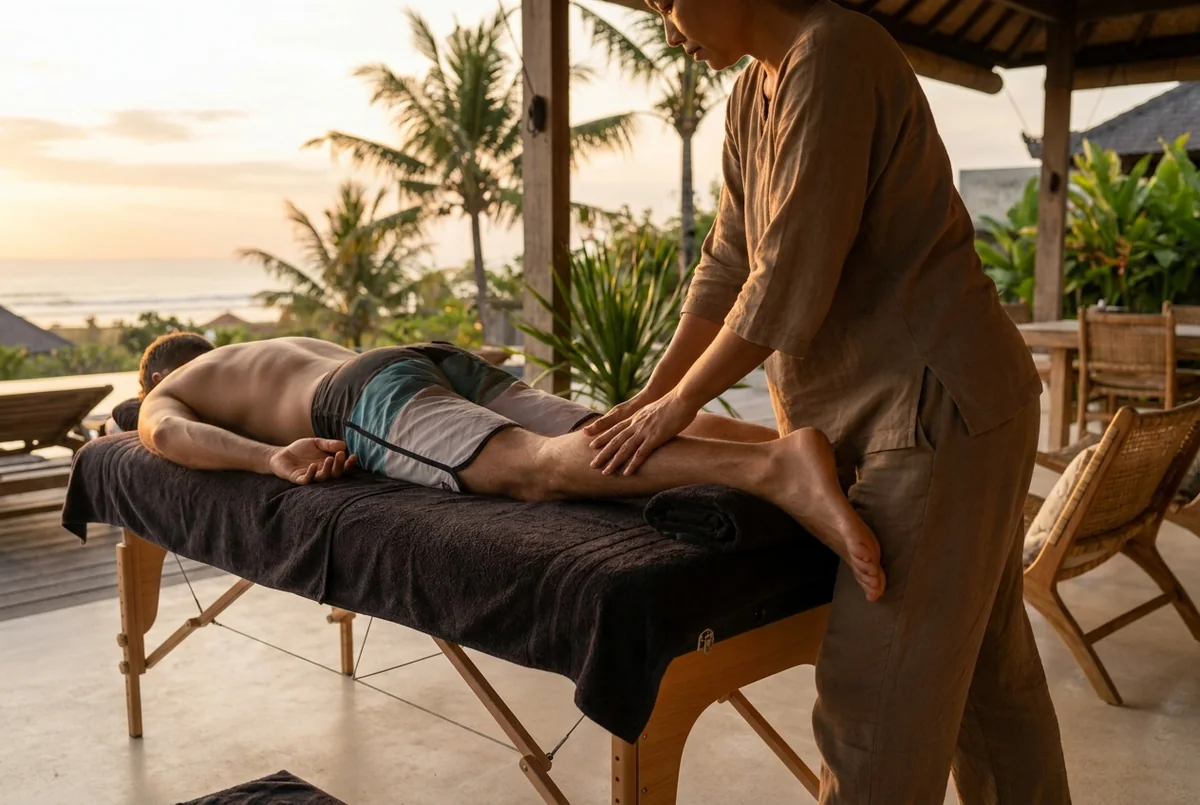
Running in Bali is gorgeous and sneaky-hard. Soft sand at Berawa, broken pavement in Canggu, the Campuhan ridge, volcano trails at sunrise — the same weekly mileage you handle easily at home lands completely differently here, and the heat starts negotiating with you from seven in the morning. Here's what island miles actually load, and where massage fits between runs.
Why Bali miles hit harder
Sand is the big one. A soft, shifting surface makes the calves, Achilles tendons and plantar fascia work overtime on stabilisation — a relaxed beach 10K can leave calves more wrecked than a hard road half. Trail descents are the other trap: running down from a ridge or crater viewpoint is heavy eccentric loading for the quads, the exact contraction type that produces the worst next-day soreness.
Then the climate. Running in tropical humidity drains fluid and electrolytes fast, which is why calves that never cramp at home suddenly cramp here. Footwear choices pile on — plenty of people run the beach barefoot for the feel of it, which is wonderful and also a sudden, unbanked load on the calves and plantar fascia that a therapist will find within seconds.
The runner's map of tight spots
Calves and the deeper soleus underneath them, the plantar surface of the feet, hip flexors shortened by both stride volume and scooter hours, the outer-hip muscles that steady every step, glutes, and a lower back that stiffens over long distances. A focused leg, calf and foot session covers the ground floor of that list; lower-back and hip work resets the top of the stride. Sandals-and-scooter life between runs shortens the calves further, which is why the first kilometre in Bali so often feels like your legs aged two years overnight.
What changes between runs
A post-long-run flush makes the next day's legs noticeably lighter — fluid moves on, the heaviness drops, and the first steps out of bed stop crunching. Plantar and calf release cuts morning foot ache, and hip-flexor work opens the stride back up after big weeks.
The honest limit: a sharp, localised pain in a shin or knee is a load problem, not a knot. Massage supports the muscles around it, but the fix is adjusting the running — pressing harder isn't a plan.
Timing: long runs and race weeks
Book the flush for the evening of your long run, not two days later. Keep deep calf and quad work at least 48 hours away from any race or key session. Racing on the island? A light flush two or three days out, then the real recovery session the evening after you cross the line. On an ordinary running week the rhythm is simpler: one flush after the biggest run, calves checked every time, and electrolytes before the massage — rehydrated muscle releases far more comfortably.
If your training alternates between running and riding, the cyclist's recovery guide covers the saddle side of the fatigue. Session lengths and rates are on the pricing page — we come to villas across all of south Bali and Ubud.