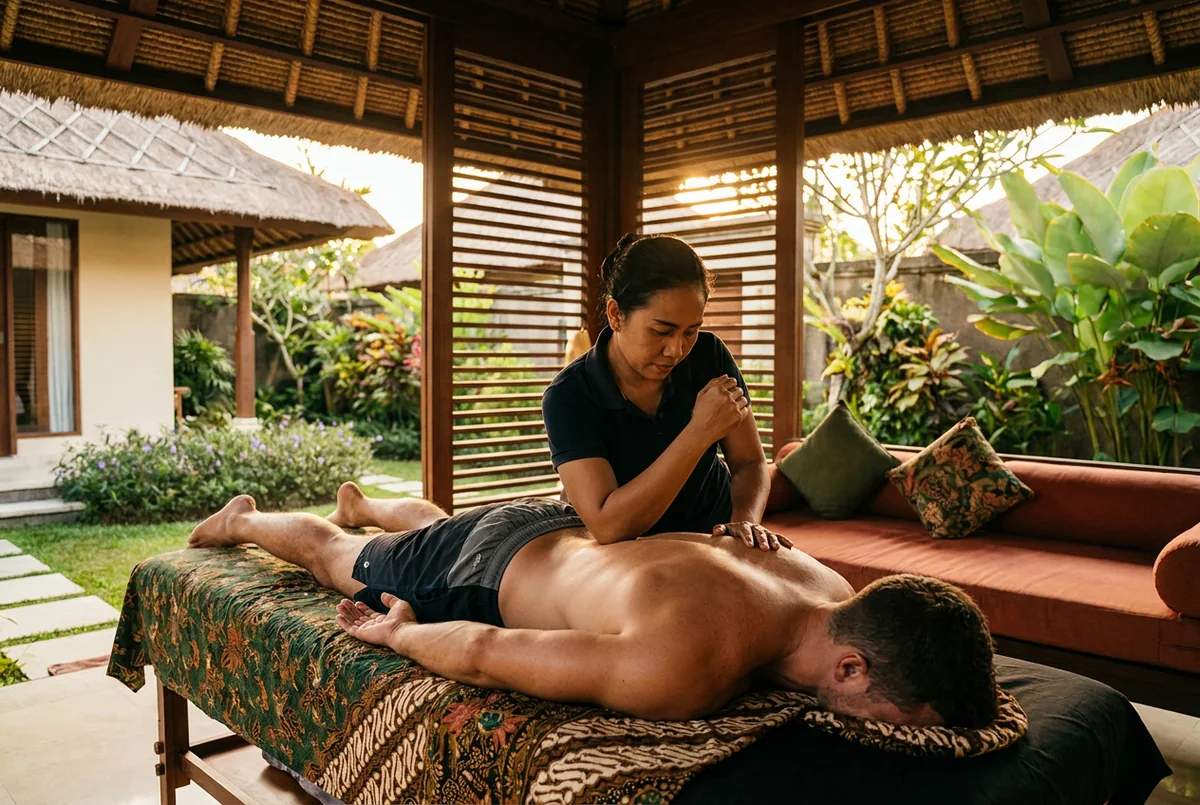
Bali has quietly become a real training destination. MMA and BJJ academies in Canggu, Ubud and on the Bukit run full timetables, and plenty of people now build an entire trip around a fight camp — two classes a day, six days a week, with partners you've never rolled with before. The training is the easy part to arrange. Absorbing it is what most visitors get wrong, and that's where recovery massage earns its place.
What a week of rolling does to your body
Grappling load is unlike almost any other sport because so much of it is isometric — long gripping contractions with barely any movement. Forearms pump up from collar ties, overhooks and gi grips until opening a water bottle feels like a task. The neck works constantly: framing, posturing out of guillotines, resisting the stack. Deep neck flexors and upper traps finish a camp week as hard as cables.
The spine takes its own beating. Closed guard, inversions and hip escapes flex and rotate the back under someone else's bodyweight, and the quadratus lumborum — the deep muscle between ribs and pelvis — grips hard after a day of bridging and shrimping. Add takedown classes your body isn't used to, and you get whole-body soreness with three or four genuinely angry hot spots.
MMA adds a second layer
If your camp mixes striking, the bill grows. Sparring rounds load the hips and shoulders through thousands of punches and kicks, head-movement drills stiffen the neck further, and wrestling exchanges hammer the whole posterior chain. What we see on the table is rarely one sore muscle — it's system-wide fatigue with a stiff neck, dead forearms and a locked lower back sitting on top of it.
What massage actually does for grapplers
Two different jobs. The first is broad flushing work that moves fluid through fatigued tissue so tomorrow's classes land on fresher muscle — the session to book between training days. The second is targeted work on grappling's signature spots: neck and trapezius release for the framing and posting load, lower-back and hip work for guard-and-bridge stiffness, and proper forearm treatment — which almost every fighter skips until their grip starts failing in round one.
For a knot that has lived in your shoulder since the first week, slow deep-tissue work on that exact spot beats another general rub-down. One honest limit: massage doesn't fix joint injuries. A knee or elbow tweaked in a late tap needs rest and assessment, not pressure.
When to book around a camp week
After a two-session day, book the same evening and keep it medium — a flushing session helps you sleep and leaves your grip working tomorrow. Save the deep, specific work for your rest day, when neck, forearms and back can be treated properly without a hard roll twelve hours later. Avoid heavy deep tissue the night before intense sparring; it can leave tissue tender exactly when you need it sharp.
We work 08:00–21:00 across Canggu, Uluwatu and the rest of south Bali, so a post-class booking is easy. If your camp leans striking, the Muay Thai recovery guide covers the kicking-and-clinch side, and session rates are on the pricing page.