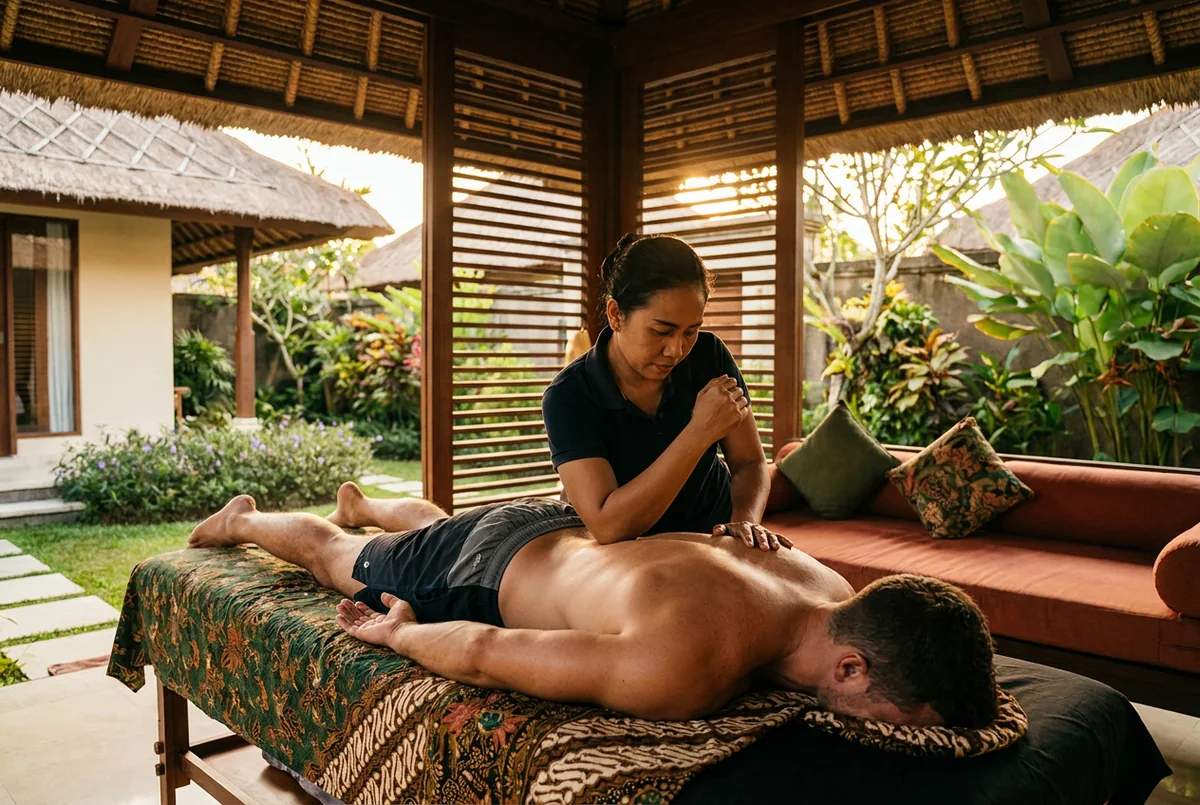
Every surfer in Bali knows the spot — the one between the shoulder blade and the spine, or deep in the back of the shoulder, that has been tight since the third day of the trip. That is paddling load, and a gentle relaxation massage will glide right over it. Deep tissue is the opposite approach: slow, deliberate pressure that sinks through the surface layers and works directly on the knot, the adhesion and the fascia underneath until it finally releases. This is a working session, not a pampering one — we ask what you've been surfing, find the restriction with our thumbs and forearms, and stay on it.
The Surfing Muscles We Target
Rotator Cuff & Rear Delt
Thousands of paddle strokes overwork the small stabilising muscles at the back of the shoulder. They knot, they refer pain down the arm, and they are first on our list.
Lats & Teres
The big pulling muscles down the side of your back drive every stroke. When they shorten and tighten they pull the shoulder forward — we lengthen and release them.
Rhomboids & Mid-Trap
The band between the shoulder blades that aches when you sit on the board. Cross-fibre work here is what finally unlocks that classic surfer's mid-back tightness.
Forearms & Neck
Gripping the rails loads the forearms; holding your head up to read the swell loads the upper trapezius and levator scapulae. Both get focused attention.
Deep Tissue or Surf Recovery — Which One?
The two services solve different problems. Deep tissue is precision work on a specific, stubborn restriction — the right move when one muscle or one spot has been tight for days and a normal massage doesn't touch it. Our broader surf recovery massage is full-body flushing and release for when you're generally wrecked after a big session and want everything moving again. Many surfers on longer trips alternate the two: surf recovery to flush after the heavy days, deep tissue to dig out the one knot that keeps coming back.
If the problem is clearly regional — only the shoulder, only the lower back, only the neck — our dedicated shoulder & rotator cuff, lower back & hips and neck & trapezius sessions go even deeper on that one area. Not sure which fits? Describe it on WhatsApp and we'll tell you honestly. For the full picture of how the two techniques differ, read deep tissue vs sports massage for surfers.
Timing It Around Your Surfing
Timing matters with deep work. The sweet spot is 24–48 hours after a heavy session, when soreness has peaked and the tissue accepts deep pressure productively; straight after an exhausting surf the lighter flushing of a recovery massage serves you better. Avoid hard deep tissue the night before a dawn patrol — freshly worked muscle can feel slightly flat for a few hours. For that, book a pre-surf warm-up instead. The complete schedule for a surf trip is in our guide to how often to get a massage on a surf trip, and the muscle-by-muscle breakdown lives in the surf muscle guide.
Pricing
| Duration | Price (IDR) | Notes |
|---|---|---|
| 60 minutes | 450,000 | Focused deep work on one or two problem areas |
| 90 minutes | 600,000 | Full upper-body and back deep tissue plus a lighter finish |
| 120 minutes | 750,000 | The full treatment: deep work head to calves with stretching |
Flat all-inclusive pricing — travel, table, oils and towels. Staying a month and surfing daily? The 5- and 10-session packages on the pricing page were built for exactly this.
How Home Booking Works
Message us on WhatsApp
Tell us the session, your area and a preferred time — or use Quick Booking. We reply within minutes, 08:00–21:00.
We confirm your therapist
You get the therapist's name, arrival time and the exact price up front. Prefer a female or male therapist? Just say so.
We arrive and set up
Professional table, fresh linens, oils and towels — set up on your terrace, by the pool or in an air-conditioned room in about five minutes.
Enjoy, pay after
Pay cash or transfer after the session. Cancellation is free up to 3 hours before your appointment.
Frequently Asked Questions
What's the difference between deep tissue and surf recovery massage?
Does deep tissue massage hurt?
Which surfing muscles need deep tissue most?
When should I book deep tissue around surfing?
Can you work around a shoulder injury?
Areas We Cover
Dig Out That Knot
Tell us where it's tight and what you've been surfing — the right therapist is one WhatsApp message away.
Book Deep Tissue