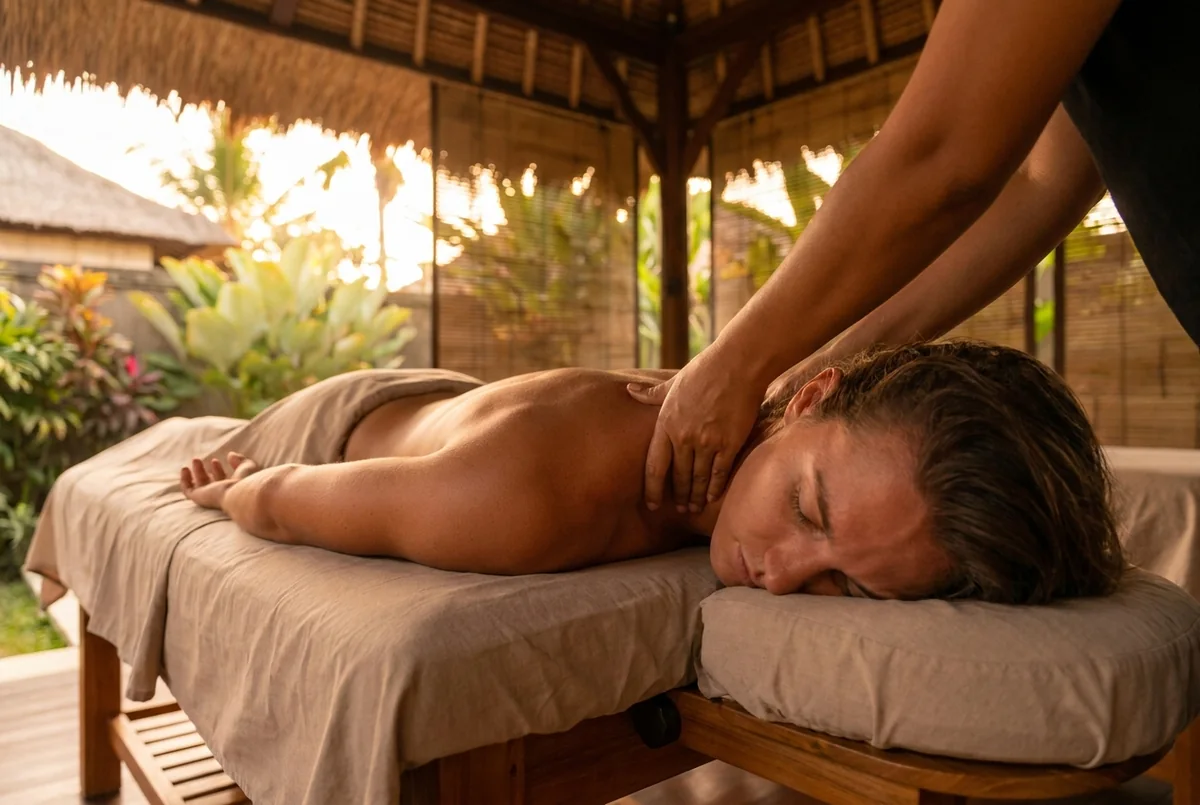
Of all the aches surfing produces, the stiff, locked neck is the one people least expect — until they realise how long they spend with their head craned up, scanning for the next set. The position is so constant that it barely registers in the moment, but the tissue keeping your head up is working the entire session. This guide explains the head-up paddling problem, the small muscles that pay for it, why it turns into a headache, and how massage and a little posture awareness clear it.
The head-up paddling problem
Picture yourself paddling: chest lifted off the board, face angled down toward the water, but eyes up, watching the horizon and the line-up. To keep your gaze forward in that prone position, your neck has to extend — chin lifted, the back of the skull dropping toward the shoulders. And you hold it there, not for a moment, but for almost the whole time you are paddling, which is most of a session.
This is cervical hyperextension under a sustained static load. The range of motion is tiny, but the muscles that hold the position never get to relax. It is the same principle that makes holding any awkward posture exhausting — the longer the hold, the more the tissue fatigues, congests and tightens. Multiply that across hours of paddling and several days of surfing, and the neck quietly becomes one of the most overloaded regions in the surf body. The full picture of how this fits with the shoulders and back is in our pillar guide to the muscles surfing uses.
The muscles that hold your head up
Several layers of muscle keep your head lifted, and each contributes to the after-session stiffness. The deepest are the suboccipitals — four tiny paired muscles at the very base of the skull that fine-tune head position. They are constantly active during head-up paddling and are notorious for getting tight and tender. Above and around them, the longer cervical extensors running down the back of the neck do the bulk of the holding work against gravity.
Then come the muscles that link the neck to the shoulder. The levator scapulae runs from the upper neck to the top inside corner of the shoulder blade, and the upper trapezius spans the neck, shoulders and upper back. Both tighten as the shoulders fatigue from paddling, pulling on the neck from below. At the front, the sternocleidomastoid (SCM) — the rope of muscle you can feel down the side of your neck — works whenever you rotate your head to watch a wave or a passing surfer. Together these give the neck no rest from any direction. Our neck & shoulder massage is built to release this whole group as a unit.
Why it becomes a headache
The neck-to-headache link surprises a lot of surfers, but it is well understood. The suboccipital muscles at the base of the skull sit right where the nerves that supply the back and side of the head emerge. When those muscles stay short, tight and congested from hours of head-up paddling, they refer pain up and over the scalp — a dull, band-like ache that often settles behind the eyes or across the back of the head. This is the classic tension or cervicogenic headache.
It usually shows up after the session rather than during it, often in the evening or the next morning, and it tends to be worse after the longest paddling days or when you have been hunched over a phone or laptop between surfs. Because the trigger is muscular, releasing the suboccipitals and upper traps frequently clears the headache directly — which is why neck-focused massage is so effective for surfers who get headaches they cannot otherwise explain.
How massage and posture awareness help
The neck responds quickly to focused work because the problem is almost entirely soft tissue. Massage releases the tight suboccipitals, cervical extensors, levator scapulae and upper traps, flushes the congested tissue, and eases the trigger points that drive the headaches. Because the neck and the paddling shoulders share so much tension, treating them together — rather than the neck in isolation — gives the longest-lasting relief. The connection to the shoulder is covered in our guide to paddling shoulder pain in surfers, and the two areas are often best treated in the same session.
Posture awareness does the prevention. Lift the head less in the water, build paddling volume gradually, keep your land posture open instead of rounded over a screen, and do a little gentle neck and thoracic mobility on rest days so the upper back shares the work instead of dumping it all on the neck. A neck & shoulder massage at your villa mid-trip keeps the tension from stacking up.
| Symptom | Likely tissue | What helps |
|---|---|---|
| Stiff, locked neck after surfing | Cervical extensors, suboccipitals | Flushing + targeted release |
| Headache behind eyes / back of head | Tight suboccipitals (referred) | Suboccipital release |
| Tension into the top of the shoulder | Levator scapulae, upper trap | Neck & shoulder massage |
| Sore turning the head | Sternocleidomastoid | Gentle SCM work + mobility |