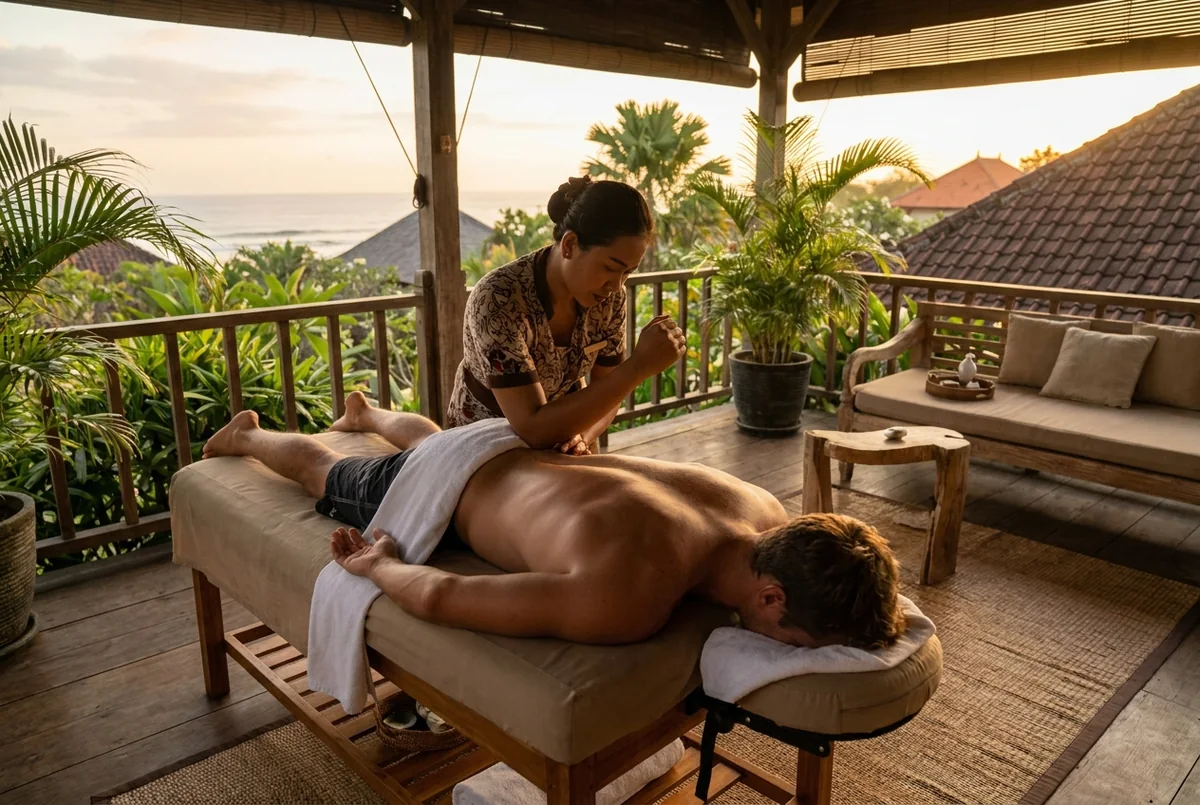
Surfing looks effortless from the beach, but a two-hour session at Uluwatu or Berawa is one of the most demanding things you can ask your body to do. Ninety percent of your time is spent paddling, which means a relentless overhead pull through the shoulders, lats and forearms. The rest is sudden, explosive, full-body effort. This guide maps every muscle group a wave recruits, explains why they "fill up" and tighten the way they do, and shows how the right massage flushes and releases each one — so you surf the next day instead of nursing your shoulders.
The four phases of a wave and what each loads
Every wave you catch runs through four distinct phases, and each one loads a different set of muscles in a different way. Understanding the sequence is the key to understanding why surfers get tight where they do — it is rarely random.
Paddling is the engine. You are face-down, arching your spine to keep your chest off the board, and pulling alternating overhead strokes for the vast majority of your session. This is an endurance load on the shoulders and an isometric hold on the lower back that simply never lets up. The duck-dive is a short, violent push-up: you sink the board with your arms and a knee or foot, demanding a burst from the triceps, chest, lats and the front of the thighs. The pop-up is the most explosive moment in surfing — a single plyometric press from prone to standing that fires the chest, triceps, core and hip flexors in under a second, repeated dozens of times a session. Riding is the sustained part: a deep, dynamic squat where your quads, hamstrings, calves and feet absorb the wave while your core and obliques rotate to steer.
The pattern that emerges is important. Surfing is overwhelmingly an upper-body endurance sport punctuated by explosive whole-body bursts — and that mix is exactly why a surf body tightens through the shoulders, lower back and calves while everything else feels merely tired. The sections below take each region in turn.
Paddling: shoulders, lats and the rotator cuff
If one region defines the surfer's body, it is the shoulder complex. Each paddle stroke is an overhead reach followed by a powerful pull-down, and you repeat it hundreds of times an hour. The latissimus dorsi — the big fan of muscle down your back — does most of the pulling, while the posterior and anterior deltoids drive the reach and recovery of each stroke. Underneath, the four small muscles of the rotator cuff (supraspinatus, infraspinatus, teres minor and subscapularis) work overtime to hold the ball of the upper arm centred in its socket through every rotation. They are not big movers; they are stabilisers, and they fatigue fast.
Supporting the main movers, the serratus anterior glides the shoulder blade forward and keeps it flat against the ribcage as you reach, the rhomboids retract it between strokes, and the triceps and forearm flexors finish each pull and cup the water. By the end of a long session, the forearms often cramp before anything else simply because they grip and brace continuously.
This is why so many surfers' aches begin at the shoulder. When the rotator cuff fatigues, the larger muscles take over and the mechanics drift, which is the origin of the classic "surfer's shoulder." If your lead arm is already complaining, our dedicated shoulder & rotator cuff massage targets exactly these structures, and the deeper anatomy of the stroke is broken down in our guide to paddling shoulder pain in surfers.
The pop-up and the arch: your lower back and hip flexors
Surfers are often surprised that their lower back hurts more than their arms, but the cause is structural. The entire time you paddle, you hold a hyperextended "cobra" arch to lift your chest off the board. That arch is sustained by the erector spinae — the long columns running either side of your spine — and the quadratus lumborum, a deep muscle in the side of your lower back. Holding that position for an hour or two is a continuous isometric contraction, and isometric holds tighten muscle faster than almost any movement.
Then comes the pop-up. Springing from prone to a standing stance fires the hip flexors — the psoas and iliacus deep in the front of the hip — to snap your knees forward under your body. Repeat that explosive flexion dozens of times and the psoas shortens. Because the psoas attaches directly to the lumbar vertebrae, a tight psoas literally pulls your lower spine into more extension, compounding the strain from the paddling arch. Meanwhile the glutes, which should drive the pop-up and stabilise the hips, are frequently underused and weak in surfers who sit a lot on land — leaving the lower back to do work the hips should be doing.
The fix is twofold: release the over-tight erectors, QL and psoas, and restore the hip mobility the pop-up steals. Our lower back massage addresses the back directly, while the hip side of the equation is covered in our articles on lower back pain from surfing and surfers' hip flexor tightness.
Holding your head up: the neck and upper traps
Here is the most overlooked load in surfing. For the entire time you paddle, your face is down toward the board but your eyes are up, scanning the horizon for the next set. That means your neck is held in constant extension — chin lifted, gaze forward — for hours. The small muscles at the base of the skull, the suboccipitals, and the longer cervical extensors contract continuously to hold that position against gravity. It is a tiny range of motion under a relentless static load, which is the perfect recipe for tension.
Layered on top, the levator scapulae and upper trapezius connect the neck to the shoulder blade and tighten as the shoulders fatigue from paddling, while the sternocleidomastoid (SCM) at the front of the neck works to rotate and stabilise the head as you turn to watch a wave. When these muscles stay short and congested, the result is not just a stiff neck — it is the dull tension headache that creeps up the back of the skull after a big day in the water.
This region responds beautifully to focused work; our neck & shoulder massage and the dedicated guide to neck pain from surfing walk through how to release it.
Balance and the duck-dive: legs, calves and feet
Your legs do the quiet, constant work of staying on the wave. Riding is essentially a long, reactive squat: the quadriceps and hamstrings absorb every bump and pump for speed, the glutes drive your turns, and your core rotates to steer. Lower down, the gastrocnemius and soleus — the two calf muscles — are under near-continuous tension as you balance and adjust, and the peroneals on the outside of the lower leg fire constantly to keep your ankle stable on a moving board.
The feet are the unsung heroes. Your toes grip, your arches load and unload, and the plantar fascia — the thick band along the sole — takes a beating, especially on a hard wax-gripped deck. This is why surfers get calf cramps and tight, sore feet that nothing on land seems to explain. The duck-dive adds a sharp burst of quad and hip-flexor work as you drive the board under, but it is the sustained balancing of riding that quietly fills the calves.
For surfers who feel it most below the knee, our leg, calf & foot massage flushes and releases the whole lower-leg chain, and the cramp question is tackled head-on in calf cramps in surfers.
Why these muscles "fill up" and fatigue
Surfers describe the feeling well: the shoulders or calves get "pumped," congested, heavy and tight, as if they are full. There is real physiology behind that sensation. Repetitive overuse — hundreds of paddle strokes, dozens of pop-ups — and sustained isometric holds (the paddling arch, the neck extension) both restrict blood flow within the working muscle. When circulation is throttled, metabolic by-products including lactate and hydrogen ions accumulate faster than the body can clear them, the tissue swells slightly, and the muscle stiffens and shortens to protect itself.
Several factors make it worse and slower to resolve. Poor recovery — surfing dawn and dusk with no real rest in between — never gives the tissue time to flush. Dehydration in Bali's heat thickens the blood and impairs the very circulation that clears waste, and it is a direct trigger for the calf and foot cramps surfers know too well. Posture on land compounds everything: hours hunched over a phone or laptop between surfs keeps the chest tight and the upper back lengthened, the exact opposite of what fatigued paddling muscles need.
How massage helps each group
Massage is not a luxury bolt-on for a surfer; it is the recovery tool that directly reverses the three things above — congestion, shortening and restricted circulation. The technique should match the problem, and a good therapist reads the body before choosing.
Flushing — lighter, rhythmic strokes that follow the muscle toward the heart — mechanically moves congested blood and metabolic waste out of "pumped" muscle and draws fresh, oxygenated blood in. This is what you want the same evening after a hard session, when the tissue is still full and inflamed. Deep tissue and trigger-point work goes after the chronic knots that build over a trip: the gripped rotator cuff, the rope-like lats, the seized QL and the stubborn soleus. This work is best 24 to 48 hours after the hardest sessions, landing on settled rather than acutely inflamed tissue. Mobility and assisted stretching restores the range surfing quietly steals — opening the chest and shoulders, lengthening the hip flexors, freeing the ankles.
The table below maps the surf load to the right service. Whatever is loudest, the cleanest place to start is our purpose-built surf recovery massage or, when the knots are deep and the trip is long, deep tissue massage. For a relaxing reset that still flushes the whole body, the Balinese recovery massage is a favourite, and before a big swell the pre-surf warm-up massage primes the muscles you are about to load.
| Surf load | Muscles involved | Best-matched service |
|---|---|---|
| Paddling & the pull | Lats, deltoids, rotator cuff, serratus, forearms | Shoulder & rotator cuff |
| The paddling arch & pop-up | Erector spinae, QL, psoas, glutes | Lower back massage |
| Head-up scanning | Suboccipitals, cervical extensors, levator scapulae, upper traps | Neck & shoulder |
| Riding & balance | Quads, hamstrings, calves, peroneals, plantar fascia | Leg, calf & foot |
| Whole-body congestion | All major groups, "pumped" tissue | Surf recovery massage |
For the timing question — how to fit recovery around surf days without losing waves — read our guides on massage after surfing in Bali and how often to get a massage on a surf trip. Between sessions, a little goes a long way: our self-massage for surfers guide shows what you can do yourself with a ball and a roller, and how deep tissue and sports massage differ is explained in deep tissue vs sports massage for surfers.