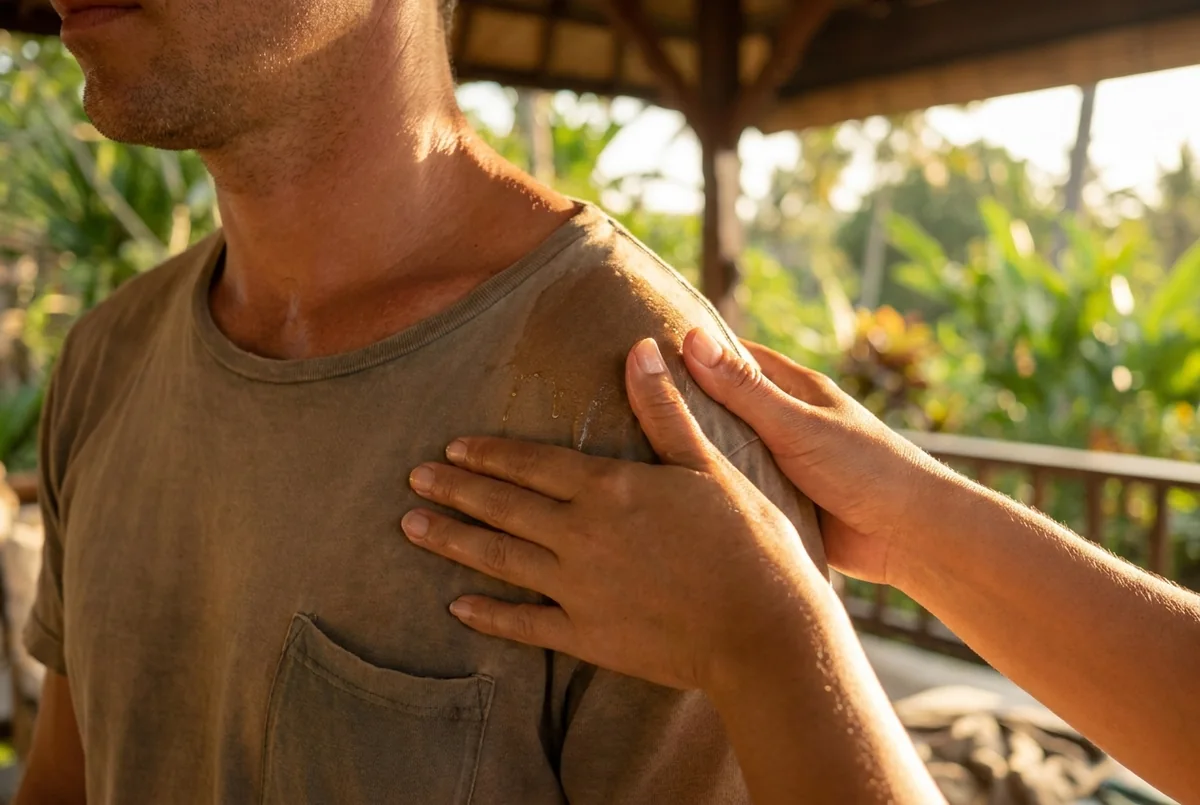
Ask a hundred surfers where the body breaks down first and most will point to the same place: the shoulder. It is no surprise — paddling is the single most repeated movement in surfing, and the shoulder is the most mobile and least stable joint in the body. This guide walks through the anatomy of the paddling stroke, the small muscles that quietly fail, what "surfer's shoulder" and impingement actually mean, why your lead arm complains first, and how the right massage releases the tissue that is pulling everything out of line.
The anatomy of the paddling stroke
A single paddle stroke is a full overhead cycle. You reach the arm forward and out of the water (the recovery), drive it down and back through the water (the pull), and repeat — hundreds of times an hour, on both sides, for the length of your session. Each part of that cycle asks different muscles to fire, and the joint that allows it all is a shallow ball-and-socket that trades stability for range of motion.
The big power for the pull comes from the latissimus dorsi and the posterior deltoid, hauling the arm down and back. The anterior deltoid and chest help reach and recover the arm. But none of this works without the stabilisers underneath, and those are what fatigue and complain. When the shoulder gets a thousand reps of overhead loading per session with almost no rest, the small muscles tasked with keeping the joint centred simply wear out — and that is where the pain starts. The bigger picture of how this fits with the rest of your surf body is mapped in our pillar article on the muscles surfing uses.
The rotator cuff and the muscles that fail first
The rotator cuff is four small muscles — the supraspinatus, infraspinatus, teres minor and subscapularis — that wrap the shoulder and hold the ball of the upper arm centred in its socket through every movement. They are not the engine; they are the steering. The supraspinatus runs through a narrow tunnel beneath the bony tip of the shoulder blade, and it is the first to suffer when paddling volume is high, because every overhead reach compresses that tunnel.
Around the cuff, several other muscles tighten and shift the mechanics. The serratus anterior should keep the shoulder blade flat and gliding as you reach; when it fatigues, the blade tips and the cuff has less room to work. The pec minor at the front of the chest shortens with all that forward reaching and pulls the shoulder forward and down, narrowing the same space. The lats become rope-tight from the constant pulling. The result is a shoulder that sits in a slightly worse position with every session — the classic set-up for irritation.
Because these are deep, specific structures, they respond best to focused hands-on work. Our shoulder & rotator cuff massage is built precisely around releasing the cuff, the deltoid, the lats and the pec minor as a unit, rather than just rubbing where it hurts.
Impingement and "surfer's shoulder"
"Surfer's shoulder" is the everyday name for overuse pain at the front and outside of the shoulder from paddling. Mechanically, it is usually a form of subacromial impingement: the space beneath the bony tip of the shoulder blade narrows, and the supraspinatus tendon and the small fluid sac that cushions it get pinched and irritated each time you raise the arm. You feel it as a sharp catch when you reach overhead, an ache deep in the shoulder afterward, and sometimes a painful arc partway through lifting the arm.
The narrowing is rarely a bony problem in surfers — it is a soft-tissue problem. Tight lats and pec minor pull the shoulder into a rounded, forward position; a fatigued cuff lets the ball of the arm ride up rather than staying centred; and a tired serratus lets the shoulder blade tip the wrong way. Each of these shrinks the subacromial space. Address the soft tissue and the space opens, which is why massage and mobility work are so effective for early surfer's shoulder. The connected tension that runs up into the neck — and often produces headaches on the same side — is covered in our guide to neck pain from surfing.
Why the lead arm goes first
Surfers almost always feel it in one shoulder before the other, and there is a clear reason. Most people have a dominant arm they instinctively pull harder with, use to steer and turn the board, and rely on when they sprint to catch a wave. That arm therefore accumulates more total paddling load and more high-intensity strokes than the other. As its rotator cuff fatigues first, the larger muscles take over, the stroke mechanics drift, and the shoulder starts riding in that compromised position — so the irritation builds on the dominant side while the other arm is still relatively fresh.
Two other factors compound it. Many surfers carry an old asymmetry from other sports or from land posture, and Bali's marathon sessions — surfing a dawn at Uluwatu then heading straight back out at Bingin — give that lead shoulder no recovery between bouts. The fix is not just to treat the painful arm but to rebalance the whole shoulder girdle and restore the cuff's ability to stabilise.
Prevention and how targeted massage helps
Prevention starts with the unglamorous basics: build paddling volume gradually rather than going from zero to all-day sessions, vary which arm leads, and keep your land posture open rather than hunched over a phone, which keeps the pec minor short. Mobility for the shoulders and thoracic spine, plus a little rotator-cuff strengthening, gives the joint the stability it needs to survive high paddling loads.
Massage attacks the problem from the soft-tissue side. By releasing the tight lats, pec minor and upper trap that pull the shoulder forward, freeing trigger points in the cuff and deltoid, and flushing the congested, fatigued tissue, a good session restores the shoulder's resting position so the joint tracks correctly and the impingement-style pinching eases. Mid-trip, this is often the difference between surfing every day and losing two to a flared shoulder.
| Symptom | Likely tissue | What helps |
|---|---|---|
| Sharp catch reaching overhead | Supraspinatus / subacromial pinch | Cuff release + open the space |
| Deep ache after paddling | Fatigued, congested cuff & deltoid | Flushing + trigger-point work |
| Shoulder sits forward / rounded | Tight pec minor & lats | Targeted shoulder massage |
| Lead arm tires far sooner | Dominant-side overload | Rebalance whole girdle |
If your shoulder is talking, the cleanest place to start is our shoulder & rotator cuff massage at your villa. For the wider system, the surf muscles guide shows how the shoulder connects to the rest, and neck pain from surfing covers the tension that so often travels up the same side.