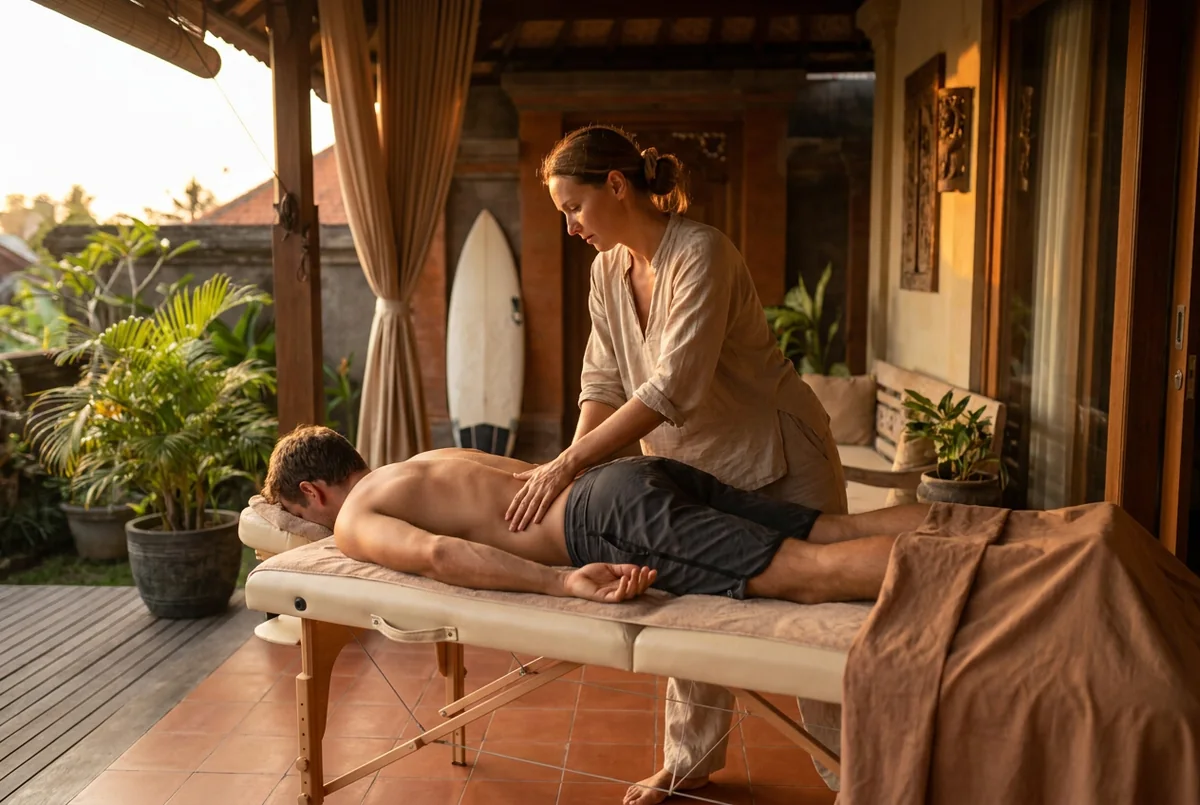
Surfers are often baffled that their lower back hurts more than their shoulders — until you look at what paddling actually asks of the spine. For the entire time you are on your board, your lower back is held in an arch, and every wave you go for adds an explosive pop-up on top. This guide explains the precise mechanics that make the lower back a surf hot spot, how to tell ordinary muscular tightness from something that needs a doctor, and how massage and mobility work bring the back back online.
The cobra arch and the pop-up
Paddling puts you in what yoga would call a cobra: face down, chest lifted off the board, lower back arched into hyperextension. You hold that position continuously — not for a few seconds, but for the bulk of a one- or two-hour session. Sustained extension like this is hard work for the muscles that hold it, and unlike a movement that comes and goes, an isometric hold never lets the tissue rest.
On top of that constant arch comes the pop-up: the explosive press from lying down to standing that you repeat every time you commit to a wave. The pop-up demands a fast, forceful contribution from the core and hips, and dozens of them per session, layered on the already-fatigued arch, is exactly why the lower back is one of surfing's most common complaints. The full map of how this region fits with the rest of your surf body is in our pillar guide to the muscles surfing uses.
The erector spinae and quadratus lumborum
Two muscle groups bear the brunt of the paddling arch. The erector spinae are the long columns of muscle running vertically either side of your spine; they are what hold your chest up against gravity for the whole session. The quadratus lumborum (QL) is a deeper, square muscle on each side of the lower back, connecting the pelvis to the lowest rib and the lumbar spine, and it works hard to stabilise you and side-bend as you reach and turn.
Held in sustained contraction, both of these fatigue, congest and shorten. You feel it as a deep band of tightness across the lower back, often a little worse on one side, that stiffens when you stand up off the board and aches into the evening. Because the QL sits deep and refers pain across the lower back and into the hip, it is a frequent hidden driver of "lower back pain" that surfers cannot quite localise. Hands-on work into these layers is the core of our lower back massage.
Tight hip flexors pulling on the lumbar spine
Here is the part most surfers miss: a lot of lower back pain does not start in the back at all. The psoas, the main hip flexor, runs from the front of your thigh up through the pelvis and attaches directly to the lumbar vertebrae. Every pop-up snaps the hips into flexion and fires the psoas hard, and all the time spent sitting on land — on flights, scooters and sofas — keeps it short. A chronically tight psoas tilts the pelvis forward and pulls the lower spine into still more extension, piling onto the load already created by the paddling arch.
This is why releasing the hip flexors so often unlocks a stubborn lower back. Treating only the back muscles while the psoas keeps dragging the lumbar spine into extension is treating the symptom, not the cause. We cover the hip side of this in detail in our guide to surfers' hip flexor tightness, and the two articles are best read together.
Weak glutes and the chain that fails
The final piece is the glutes. The gluteal muscles are designed to drive the pop-up, extend the hip and stabilise the pelvis — taking load off the lower back. But surfers who sit a lot on land tend to have underused, weak glutes, so when the pop-up fires and the hips need to stabilise, the lower back muscles step in to do work they were never meant to do. Over a trip, that overload is what turns end-of-day stiffness into a back that complains every session.
The picture, then, is a chain: tight hip flexors at the front, weak glutes at the back, and over-tight erectors and QL in the middle taking the strain. Lasting relief comes from addressing the whole chain — releasing what is tight, waking up what is weak, and restoring the hip mobility the sport steals.
Tightness versus something that needs a doctor
Most surf-related lower back pain is muscular — tired, tight, congested tissue that responds to rest, mobility and massage. It is achy rather than sharp, it tends to ease with gentle movement and warmth, and it improves over a rest day. That is the kind of back the right bodywork resolves quickly.
Some symptoms, though, are signals to stop and see a professional. Sharp or shooting pain, pain that radiates down a leg, numbness, tingling or weakness in the leg or foot, pain that steadily worsens rather than easing with rest, or — rare but urgent — any loss of bladder or bowel control all point beyond simple muscular tightness toward a disc, nerve or joint problem. Massage is not the answer for those; a doctor or physiotherapist is. A good therapist will recognise these signs and refer you rather than work on them.
| Feels like | Likely cause | What to do |
|---|---|---|
| Deep band of tightness, both sides | Fatigued erector spinae | Flushing + lower back massage |
| One-sided ache into the hip | Quadratus lumborum trigger points | Targeted deep work |
| Back tightens, hips feel locked | Short psoas / hip flexors | Release hips + mobility |
| Sharp, shooting or radiating pain | Possible disc / nerve issue | See a doctor first |
How massage and mobility fix it
For ordinary muscular surf back, massage works on every link of that chain. It releases the over-tight erector spinae and QL, frees the psoas and hip flexors that pull on the lumbar spine, and flushes the congested tissue so fresh blood can do its repair work. Paired with mobility — opening hip extension, mobilising the thoracic spine so the lower back is not forced to do all the bending, and reactivating the glutes — it takes the strain off the lumbar spine for good rather than just for the evening.
On a surf trip, a lower back massage at your villa mid-week often keeps a niggle from becoming the thing that ends your sessions. For a broader reset that flushes the whole posterior chain, the deep tissue massage is ideal, and the timing logic — when to go deep versus light — is in our guide to massage after surfing in Bali.