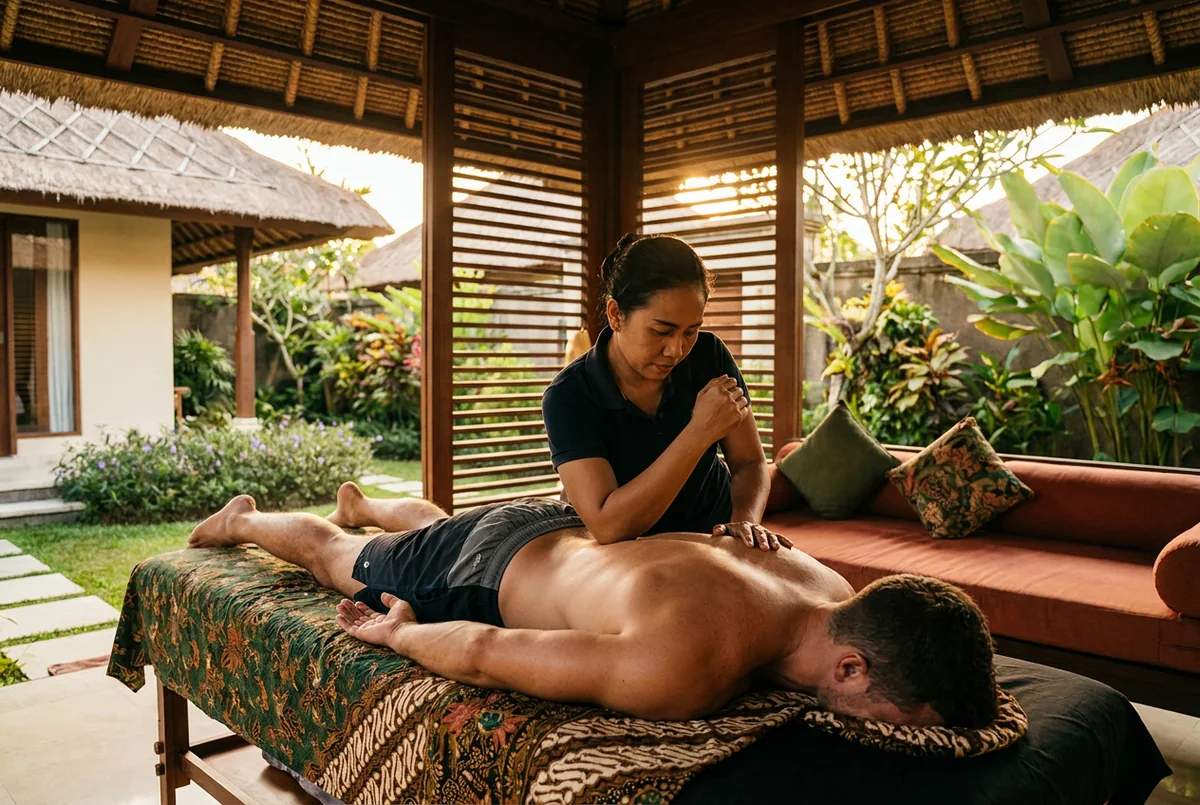
You score a glassy dawn session at Berawa, paddle for two hours, and the next morning your shoulders, lower back and calves feel like they belong to someone else. That is the price of good waves — and recovery massage is the cleanest way to pay it down. This guide covers exactly what a surf day does to your body, why the soreness peaks a day later, and how to time deep tissue and lighter flushing across a multi-day trip so you keep surfing instead of sitting it out.
Which muscles a surf day wrecks
Surfing is deceptively one-sided. The overwhelming majority of a session is paddling, which means hour after hour of overhead pulling through the shoulders, latissimus dorsi and rotator cuff, with the forearms gripping and bracing the whole time. Beneath that, your lower back holds a continuous arch to keep your chest off the board, loading the erector spinae and quadratus lumborum isometrically — which is why the back so often hurts more than the arms.
The explosive moments add their own toll. Every pop-up fires the chest, triceps and hip flexors, and dozens of them per session leave the front of the hips tight. Once you are riding, the quads, hamstrings and calves absorb the wave in a long reactive squat, while the neck stays craned up to read the horizon. For the full anatomical breakdown of each phase, see our pillar guide to the muscles surfing uses.
The science of post-surf soreness (DOMS)
The ache that arrives the morning after — and often peaks 24 to 48 hours later — is delayed-onset muscle soreness, or DOMS. It is not lactic acid; that clears within an hour of finishing. DOMS comes from the microscopic damage that eccentric, lengthening-under-load contractions cause inside muscle fibres: think of your quads absorbing a drop, or your shoulders decelerating each paddle recovery. The body responds with a small inflammatory repair process, and it is that inflammation and the associated swelling — not lactate — that you feel as stiffness and tenderness.
On top of DOMS sits the more immediate "pumped" feeling: congested, heavy muscle full of fluid and metabolic by-products that the throttled circulation of sustained work could not clear fast enough. Bali's heat compounds it, because dehydration thickens the blood and slows the very circulation that flushes waste and feeds repair.
This is exactly where massage earns its place. Gentle, rhythmic flushing strokes mechanically move congested blood and waste out of the tissue and draw fresh, oxygenated blood in, easing the heavy feeling and supporting the repair process. Deeper work, applied at the right time, breaks up the chronic adhesions that build over repeated sessions. A purpose-built surf recovery massage is designed around precisely this sequence.
Deep tissue versus lighter flushing — the 24–48h rule
The most common mistake surfers make is asking for the deepest possible massage straight after the hardest session. When tissue is acutely inflamed and full from DOMS, heavy deep-tissue pressure can add to the soreness rather than relieve it. The better approach follows a simple timing rule.
The same evening as a hard surf: go lighter. A flushing recovery massage moves congestion, calms the nervous system and helps you sleep — which is itself a huge recovery lever. 24 to 48 hours later, or mid-trip: this is the window for deep tissue massage, when the acute inflammation has settled and the therapist can work into the chronic knots in the rotator cuff, lats, QL and soleus without aggravating fresh damage. The difference between these two techniques, and when each is right for a surfer, is explained in detail in deep tissue vs sports massage for surfers.
How to schedule massage across a surf trip
The goal on a surf trip is simple: never let tightness accumulate to the point where it costs you a session. The trick is to vary the work rather than repeat the same heavy massage daily. Light flushing can be done every day with no downside; maximum-pressure deep tissue should be spaced out so the tissue recovers between treatments.
A pattern that works well for a typical week of surfing looks like this — flushing on the heaviest surf days, deep tissue on a lighter surf or rest day, and a region-specific session whenever one area is clearly the loudest.
| Day | Surf load | Best massage |
|---|---|---|
| Big dawn session | Heavy paddling, many pop-ups | Same-evening light flushing / surf recovery |
| Lighter surf or rest day | Tissue settled from prior day | Deep tissue on the tightest areas |
| One region screaming | e.g. lead shoulder, lower back, calves | Targeted region service |
| Before a big swell | About to load cold muscle | Pre-surf warm-up |
For the deeper logic on frequency — how many massages a week, and how to read your own body — see our companion guide on how often to get a massage on a surf trip. Because we come to your villa anywhere in Canggu, Uluwatu, Berawa and beyond, every day from 08:00 to 21:00, you can book a session for the evening you paddle out and never build a trip around a spa appointment. For a gentler full-body reset that still flushes, many surfers love the Balinese recovery massage.