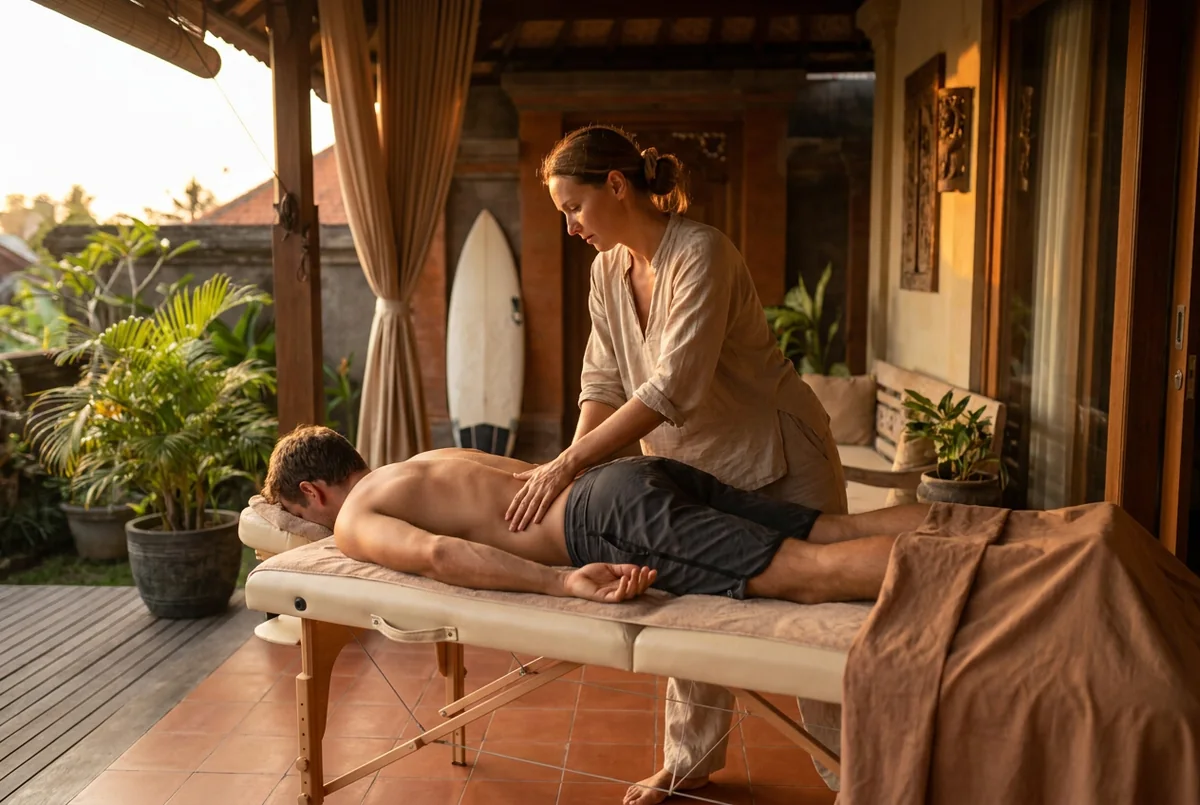
Almost every surfer who comes to us complaining of a stiff, achy lower back actually has tight hip flexors driving the problem. The hips do an enormous, unglamorous amount of work in the water — and then you climb out and sit down for the rest of the day. This guide explains the muscles involved, why surfing loads them so heavily, and how a combination of focused massage and honest daily stretching gives you your hips back.
Which muscles we mean by "hip flexors"
The hip flexors are a small group of muscles on the front of the hip and the front of the thigh that lift your knee toward your chest and bring your trunk forward over your legs. The headline act is the psoas major, a long, thick muscle that runs from the front of your lumbar spine, dives down through the pelvis, and attaches to the inside of the thigh bone. Working alongside it is the iliacus, which lines the inside of the pelvic bowl — together they are often called the iliopsoas. Crossing the front of the thigh is the rectus femoris, the only one of the four quadriceps muscles that also crosses the hip, so it both extends the knee and flexes the hip.
What makes the psoas so important — and so troublesome — is its direct attachment to the lumbar spine. Unlike most muscles that simply move a limb, the psoas physically connects your leg to your lower back. When it shortens and tightens, it does not just feel stiff at the hip; it pulls on the spine itself. That single anatomical fact is why hip-flexor tightness and lower-back pain are so often the same problem wearing two different costumes.
Why surfing leaves hip flexors chronically short
Surfing attacks the hip flexors from three directions, and then everyday life finishes the job. The first is the paddling position. Lying prone on the board, you hold your chest and head up in a constant low-grade back arch, which means the hip flexors and lower-back muscles co-contract to keep that posture for minutes at a time. It feels like a back position, but the front of the hip is working hard to hold the pelvis in place against the board.
The second is the pop-up. This is a fast, explosive movement where you drive the knees forward and snap from lying to standing in a fraction of a second. That motion is pure hip flexion under speed and load, repeated dozens or hundreds of times a session. Explosive, repeated firing without a matching stretch is a classic recipe for a muscle that adapts by getting shorter and tighter rather than longer and looser.
The third is the most underrated: sitting on the board. Between sets you straddle the board with your hips bent, often for long stretches in a glassy lull, waiting and watching the horizon. The hips are held in deep flexion the whole time. Then you paddle in, dry off, and sit — in the car, at the warung, at the laptop. The psoas spends almost its entire day in a shortened position and almost none of it being lengthened. Muscles adapt to the position they live in, and a surfer's hip flexors live bent.
How tight hip flexors feed lower-back pain
Here is the chain that we explain to clients on the table most weeks. A short, tight psoas pulls the front of the lumbar spine and the pelvis downward and forward, tipping the pelvis into what is called an anterior pelvic tilt. Picture the pelvis as a bucket of water tipping forward and spilling out the front. That tilt deepens the natural curve of the lower back, jamming the small facet joints of the spine together and forcing the spinal erectors to work overtime to hold you upright.
The result is a lower back that feels permanently tight, tired and achy — especially when standing for a while or first thing in the morning. Crucially, the back muscles themselves are usually the victims, not the culprits. You can massage and stretch the lower back endlessly, but if the psoas keeps tugging the pelvis forward, the ache returns within a day. This is exactly why so much of our lower-back massage work for surfers actually starts at the front of the hip, not the back — and why our deeper write-up on lower-back pain from surfing keeps coming back to the hips.
Tight hip flexors also quietly switch off the glutes through a reflex called reciprocal inhibition: when the muscle on one side of a joint is chronically short, its opposite tends to go lazy. Weak, sleepy glutes mean even more load lands on the lower back and the hamstrings during paddling and pop-ups, and the whole pattern reinforces itself. Breaking it means restoring length at the front of the hip first.
What massage actually does for the hip flexors
The iliopsoas is a deep muscle, partly hidden behind the abdominal organs and the pelvic bones, so it is not a structure you can dig into carelessly. A skilled therapist works it through slow, patient, well-positioned pressure — easing into the tissue at the front of the hip and along the inner thigh, waiting for the muscle to soften rather than forcing it. The rectus femoris and the surrounding quadriceps are far more accessible and respond beautifully to deep-tissue work that breaks up the adhesions left by repeated explosive pop-ups.
The reason massage outperforms stretching alone is that a chronically tight muscle holds protective tension that a stretch cannot always reach. Sustained manual pressure calms the nervous system's grip on the muscle, letting it release to a new resting length. Once the therapist has created that slack, stretching locks it in. We almost always pair hip-flexor release with assisted stretching on the table and a simple home routine, because length you do not maintain is length you lose within a week.
Stretching and prevention you can do yourself
The single best stretch is the half-kneeling hip-flexor lunge. Drop one knee to the floor, the other foot forward and flat. Before you move anything, tuck your tailbone under and squeeze the glute of the kneeling-side leg — this is the part everyone skips, and it is what actually targets the psoas. Then ease your weight gently forward until you feel a stretch across the front of the hip, not the lower back. Hold 30 to 45 seconds, breathe slowly, and repeat on both sides. Do it after surfing while the tissue is warm.
For prevention, the goal is simply to interrupt the all-day bent-hip position. Stand up and walk every 30 to 45 minutes when you are working or driving. On rest days, add the lunge stretch and some glute activation so the front and back of the hip stay balanced. And book a proper pre-surf warm-up massage before big sessions or contests, which opens the hips and primes the pop-up so you are not asking a cold, shortened psoas to fire explosively on your first wave. If you want the full picture of how the hips sit within the rest of the surfing body, our surf muscles guide maps the whole chain.